The “City of Crystal”
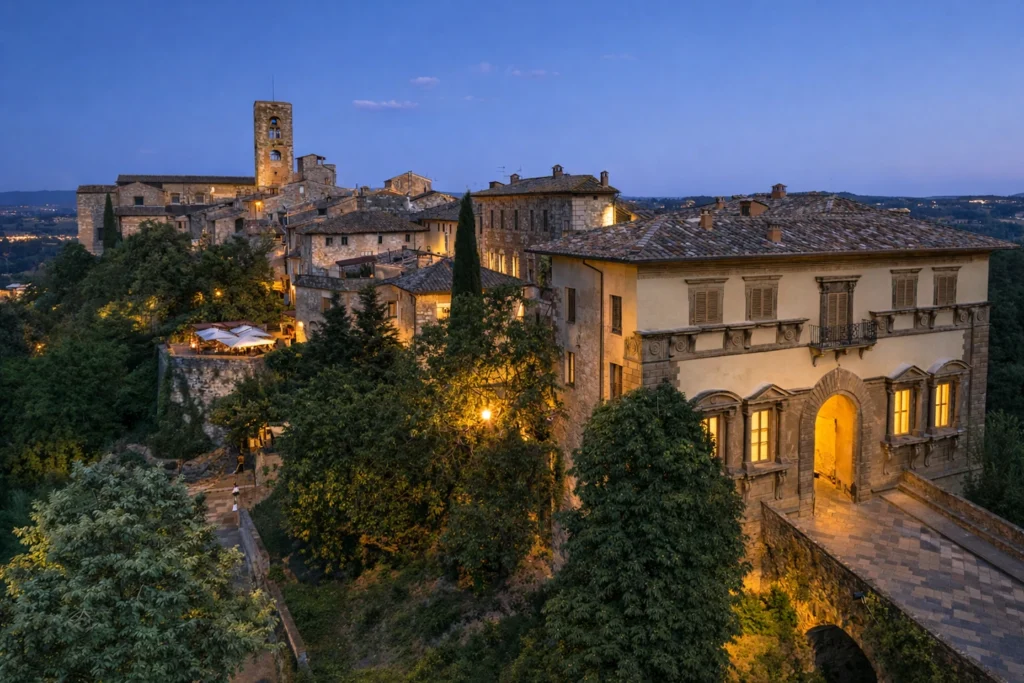

Colle di Val d’Elsa is a town built on a clear, almost architectural idea, two levels, Colle Bassa and Colle Alta, each with its own rhythm, stitched together by walls, gates, and an urban system designed to move people through history without turning the visit into a performance. The nickname “City of Crystal” is not a marketing invention, the town’s identity is tied to glass and crystal-making on an industrial and artistic scale, so much so that the municipality itself presents Colle as a major Italian, and internationally relevant, centre for crystal production.

What to see in Colle di Val d'Elsa
Begin at Porta Nuova, also known as Porta Volterrana, a late-15th-century fortification that feels more like a compact fortress than a simple city gate. Two powerful circular towers enclose a short stretch of walls, a signature of Renaissance military architecture, and recent studies have even brought back to light the line of the old moat. It’s one of those places where you immediately understand how seriously this territory once took defence, engineering, and borders.
In Colle Alta, keep your attention on the town’s civic intelligence, Museo San Pietro is an excellent key, because it doesn’t isolate art from context. The route moves between diocesan sacred heritage and civic collections, and it closes with the section devoted to Romano Bilenchi, writer and intellectual born in Colle, where a curated selection of his library sits alongside works by important 20th-century artists such as Ottone Rosai, Moses Levy, and Mino Maccari. It’s a museum that reads the town as a cultural organism, not as a sequence of pretty rooms.
To understand the crystal soul in a concrete way, the Museo del Cristallo is the right stop. Set in the former Boschi glassworks area, the museum is conceived as a multi-level route beneath the old factory chimney, tracing Colle’s local glass industry from the 19th century through the decisive affirmation of lead-crystal and its modern evolution. It’s technical, material, and surprisingly elegant, because it lets the craft speak through processes, tools, and design rather than nostalgia.
Colle also has a distinctive piece of contemporary infrastructure-as-experience, the Risalita del Baluardo, inaugurated in 2006, connects Via Meoni, in the lower town, to the Baluardo in Colle Alta, turning a practical climb into a designed passage. Once at the top, the Baluardo functions as a true urban terrace, an edge of the fortified system that opens the perspective over the lower town and gives you a clean sense of Colle’s two-part anatomy.
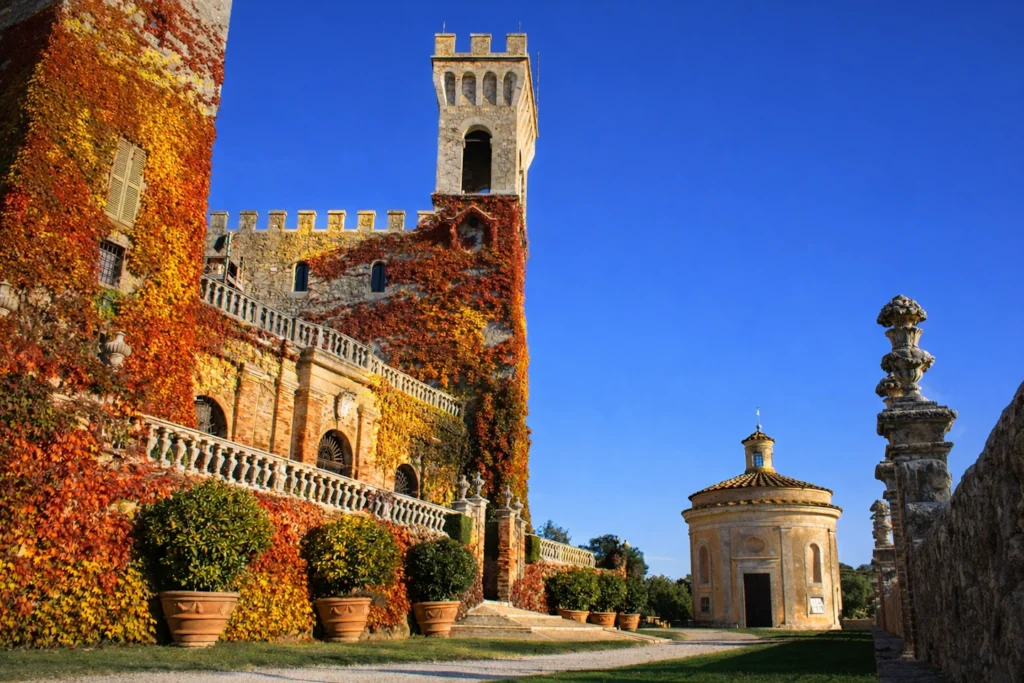
Nearby - Castello di Celsa
Close to Colle Val d’Elsa, there are a few curious places that feel like discoveries, and Castello di Celsa is one of the most rewarding. It lies along a quieter secondary branch of the Via Francigena on the way toward Siena. The site began as a 13th century stronghold, yet its most distinctive identity comes from a major 16th century renewal commissioned by the Sienese Celsi family, traditionally attributed to Baldassarre Peruzzi. What lingers in memory are two clear signatures, the elegant circular chapel, and the long terraced retaining wall along the approach, punctuated by a measured sequence of niches, a compact Renaissance lesson in proportion and rhythm. It shows how a fortress became a cultivated residence without losing its gravity.