The “Gothic City”
Siena is instantly recognisable for the warm brick of its streets and palaces, for the dramatic bowl of Piazza del Campo, and for a city identity that still feels unusually intact. Its Historic Centre has been a UNESCO World Heritage Site since 1995, and part of its power lies in the way art, devotion, and civic politics remain legible in the urban fabric, not as isolated monuments, but as a continuous medieval organism. Siena was shaped by the proud autonomy of a commune, by intense rivalry with Florence, and by a culture that turned painting, sculpture, and public ritual into a language of collective identity, still visible today in museums, churches, contrade, and the living theatre of the Palio.
What to see in Siena
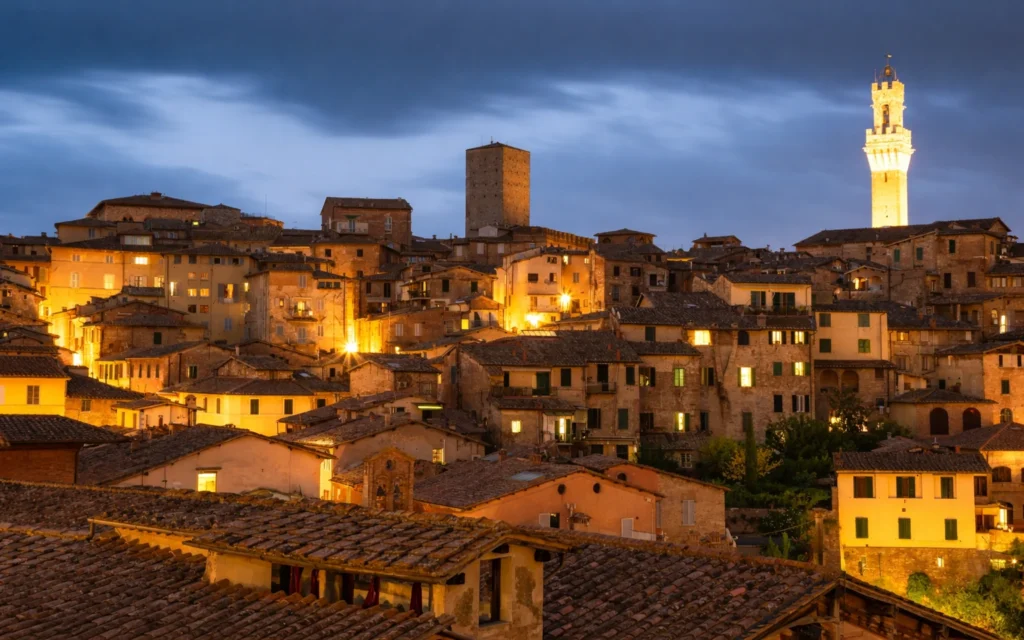
Begin where Siena explains itself in a single glance, Piazza del Campo. The square is not only beautiful, it is a civic instrument, a shell-shaped space designed for assembly, spectacle, and government, sloping like an amphitheatre toward the Fonte Gaia. On the square’s edge, the Palazzo Pubblico is the city’s political core made stone. Inside, the Museo Civico brings you directly into Siena’s moral and artistic imagination, especially through Ambrogio Lorenzetti’s frescoes in the Sala della Pace, a civic masterpiece painted in 1338 that turns government into a visible ethical project. Then climb the Torre del Mangia, Siena’s great vertical counterpoint to the Campo, to read the city as a geometry of roofs, ridgelines, and towers, and to understand how tightly Siena’s beauty is bound to proportion and power.
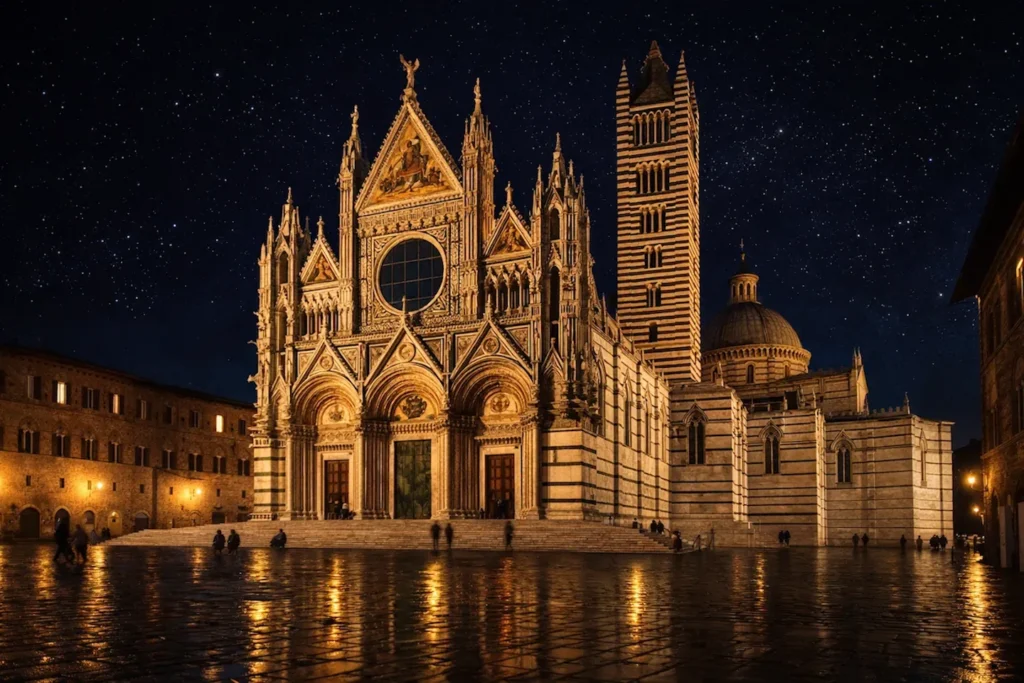
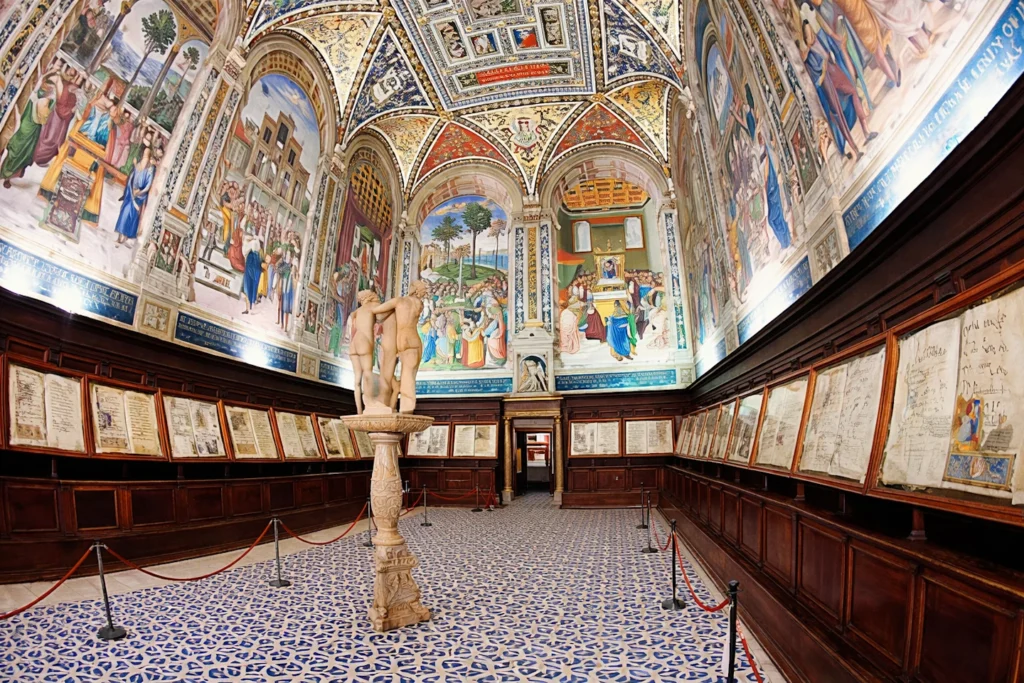
From civic Siena, move to sacred Siena with a short walk that feels like a hinge in the city’s identity: the Duomo complex. Siena Cathedral is an overwhelming interior experience, built to be read slowly, marble, light, rhythm, and an almost musical alternation of surfaces. Give real time to the Libreria Piccolomini, a jewel-box of Renaissance painting where Pinturicchio’s fresco cycle turns the life of Enea Silvio Piccolomini, later Pope Pius II, into a luminous narrative of ambition, diplomacy, and humanist self-fashioning. The cathedral’s inlaid marble floor is another signature, a work that belongs as much to the history of drawing as to architecture, and it is often uncovered for visitors in specific periods, which makes the experience feel like entering a living workshop rather than a fixed monument. Siena rewards guests who treat the Duomo not as “a church”, but as a whole cultural system of spaces and images.
To complete that system, add the Museo dell’Opera and the Panorama viewpoint commonly known as the Facciatone. This is where Siena’s unfinished plans become a privilege for the visitor: you step into an architectural “what if” that turns into one of the most memorable city views in Tuscany. From up there, Siena reads as a dense medieval field of roofs punctuated by bell towers, and the countryside beyond appears not as generic landscape, but as the true stage of Siena’s historic wealth and pride. The Opera route also helps you connect the city’s greatest artworks to their original civic-religious setting, reminding you that Sienese painting was never meant to be detached from ritual, processions, and communal identity. If you want Siena in a single sentence, it is this: art here is not decoration, it is citizenship.
Just opposite the Duomo, step into one of Siena’s most distinctive cultural experiences, Santa Maria della Scala. Once a major hospital and a key institution for care and hospitality on the Via Francigena, it has become a vast museum complex that still feels like an inhabited piece of the city rather than a neutral exhibition space. The scale is part of the impact, long corridors, courtyards, layered rooms, and the sense that Siena’s public life was built not only on pride, but on organised care, administration, and a surprisingly modern civic intelligence. It is also a perfect stop for guests who want a deeper, less obvious Siena, because it shifts the focus from “monuments” to the infrastructure of medieval life, charity, pilgrimage, and the everyday realities that held the city together.
If your aim is explicitly art and culture, give Siena at least one museum that frames the city’s painting as a school, not a set of isolated masterpieces. The Pinacoteca Nazionale is the cleanest way to do that, because it lets you read the Sienese line from the early giants through the city’s lyrical Gothic refinements, and it makes clear why Siena mattered so decisively in the story of Italian art. Then balance “museum Siena” with “walking Siena”: follow Via di Città and the quieter lanes that drop and rise behind the Campo, notice the contrada symbols on corners and fountains, and let the city’s scale work on you. Siena is at its best when you move slowly enough to feel how ritual, identity, and space are still stitched together.
To complete the visit with one distinctly local layer, give space to the Contrade and the Palio. Even outside race days, Siena’s neighbourhood identities are not folklore, they are living micro-institutions, with museums, oratories, and a strong sense of belonging that explains the city’s emotional intensity. If you are in town near 2 July or 16 August, you can feel how the Campo becomes a theatre of collective memory and disciplined passion, a form of culture that is not “performed for tourists” but generated from inside the city’s own structure. Done well, Siena leaves you with the impression of a place where beauty is not a surface, but a social pact.
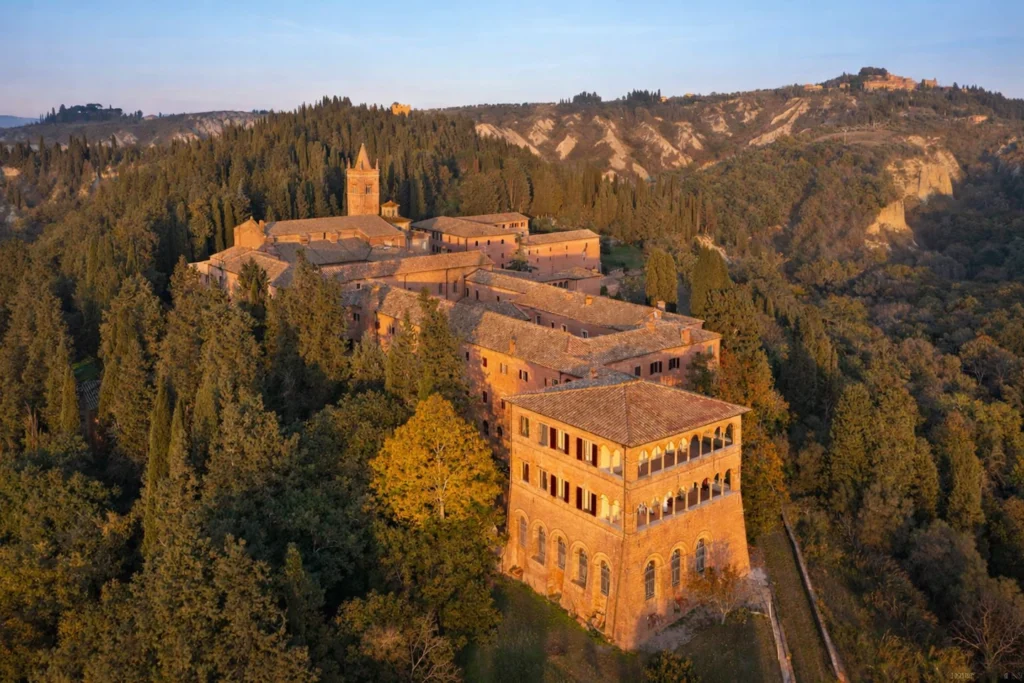
Nearby - Abbey of Monte Oliveto
If you want a nearby excursion that stays firmly within art and contemplative culture, Monte Oliveto Maggiore is an exceptional choice. Set in the Crete Senesi landscape, the abbey feels like a deliberate pause after Siena’s density, quieter, more spacious, and deeply architectural. It was founded in 1313 by Bernardo Tolomei and approved by Pope Clement VI in 1344, and its identity is still that of a living monastic world rather than a museum-only destination. The real highlight for many visitors is the great cloister fresco cycle that turns monastic life into an unfolding visual narrative, while the surrounding countryside, pale earth, lines of cypresses, and wide horizons, makes the approach itself feel like part of the experience. It is a “nearby” that genuinely adds something different: silence, proportion, and art made for reflection.