The “City of Gold”
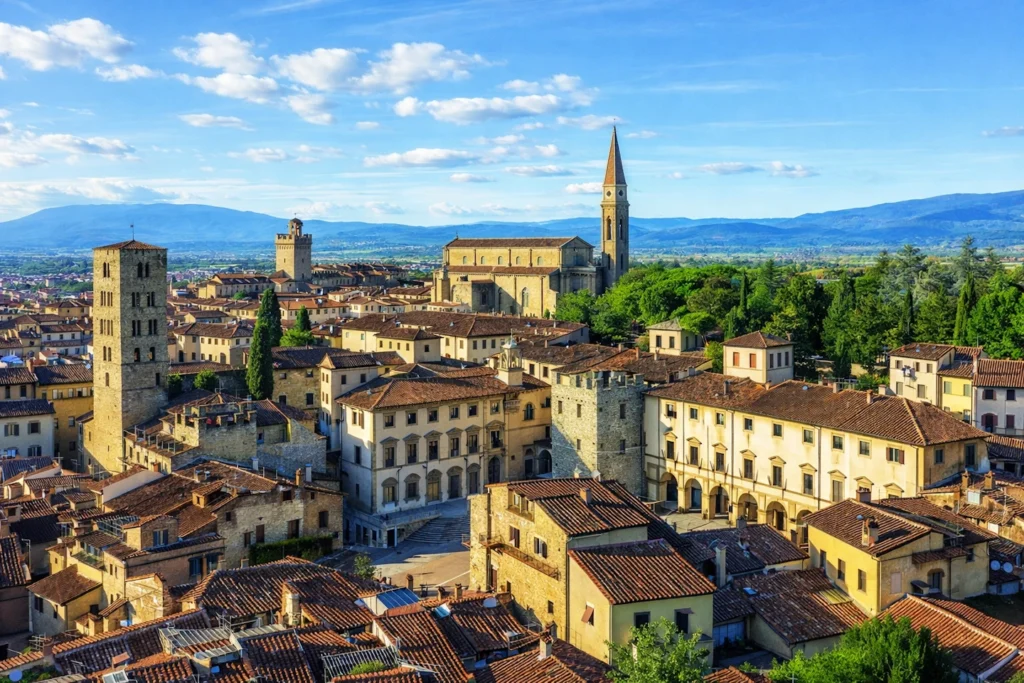
Arezzo is instantly recognisable for its sloping medieval streets, the theatrical geometry of Piazza Grande, and a cultural identity that feels both ancient and surprisingly active. It is often called the “City of Gold” because the territory is one of Italy’s most important centres for goldsmithing and jewellery manufacturing, a modern craft-economy that sits naturally beside the city’s older artistic DNA. What makes Arezzo special for an art and culture day trip is exactly this double register: a Roman and medieval city that holds one of the decisive Renaissance painting cycles in Italy, while also remaining a place of workshops, trade, antiques, and lived urban rhythm.
What to see in Arezzo
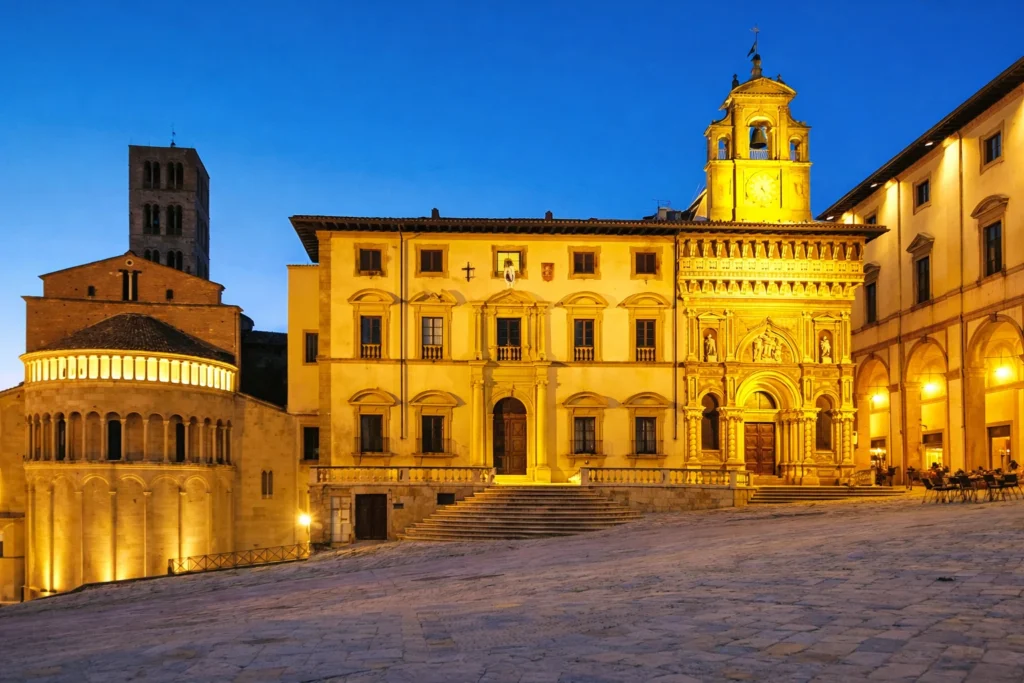
Begin in the city’s most distinctive civic stage, Piazza Grande. It is not a “perfect” square and that is the point: it is a sloped, asymmetrical space where Arezzo reads as a real medieval organism, shaped by terrain, power, and practical life. Let the façades and the changing levels do their work on you, then step into the surrounding streets to feel how quickly the city shifts from monumental to intimate.
From civic space, move straight to the artistic heart, Basilica di San Francesco. The church holds Piero della Francesca’s fresco cycle of the Legend of the True Cross, one of the most important pictorial narratives of the Italian Renaissance and the reason many art lovers come to Arezzo in the first place. This is a visit to do slowly, with time to let Piero’s light, geometry, and calm intelligence accumulate, scene after scene, until the cycle stops being “a famous artwork” and becomes a complete visual world.
Then give space to Arezzo’s Romanesque strength with Santa Maria della Pieve and the historic centre around it. This is the Arezzo that feels older than Renaissance brilliance, stone, rhythm, façade language, bell tower, and the sense of a city that kept building without erasing its earlier self. Pair it with an unhurried walk along Corso Italia and the side streets that climb and drop, because in Arezzo the pleasure is often in proportion, corners, and quiet transitions rather than in a single “big reveal”.
To add depth, choose one museum layer that fits your taste. If you want the city’s Roman chapter to feel concrete, go to the Museo Archeologico Nazionale “Gaio Cilnio Mecenate” and the adjacent Roman amphitheatre area, a direct encounter with Arezzo as an ancient urban centre rather than only a medieval hill city. If, instead, your focus is painting and the local school, the Museo Statale d’Arte Medievale e Moderna gives you a coherent route through Arezzo’s artistic texture across centuries, not as isolated highlights but as a readable tradition.
Arezzo is also the birthplace of Giorgio Vasari, and Casa Vasari is one of the most satisfying “small” museum experiences in Tuscany: personal, historically specific, and intellectually alive, a way to meet the Renaissance not only as masterpieces but as mind, method, and biography. If your day overlaps with the first weekend of the month, consider the Fiera Antiquaria. It changes the city’s atmosphere, turning streets and piazzas into a moving landscape of objects, taste, collecting, and conversation. Even for visitors who do not buy, it is a cultural experience in itself because it shows how Arezzo still functions as a place of trade and material memory, not only of monuments.
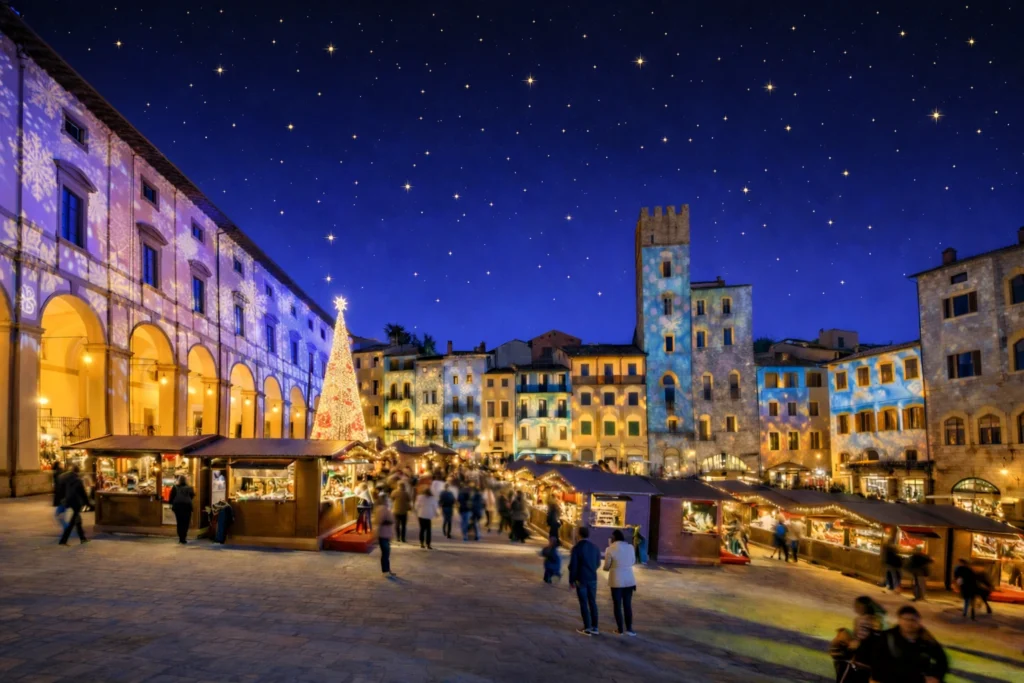
If you are staying at Villa Vianci in late autumn or winter, there is one seasonal reason to choose Arezzo: Arezzo Città del Natale. The historic centre, and especially Piazza Grande, becomes a Christmas stage with markets, lights, installations, and a strong “event-city” energy that feels unusually complete for a Tuscan town. It is widely considered one of the most significant Christmas events in the region, and it works well as a day trip because it blends atmosphere with real architecture, rather than replacing the city with a temporary fairground.
Finally, connect the “City of Gold” identity to something tangible. Arezzo’s role in the jewellery sector is not anecdotal, it is a real industrial and export system that continues to shape the territory, and it helps explain why the city feels both historic and economically alive.
Nearby - Cortona
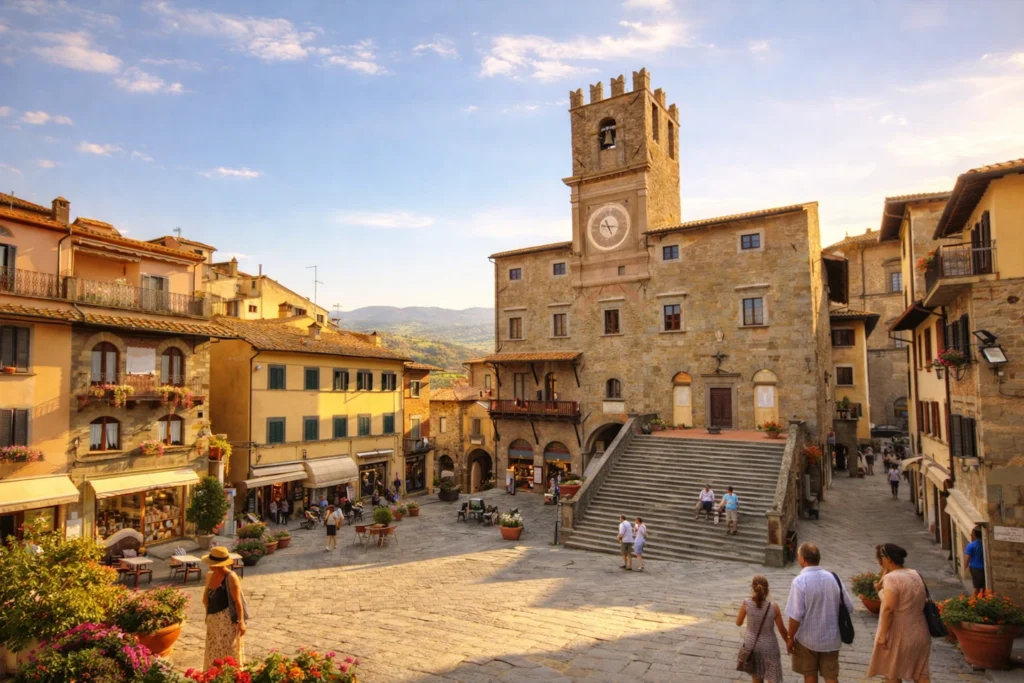
If you want a nearby excursion that shifts the day from major city monuments to a tighter, more “archaeological plus Renaissance” focus, Cortona is an excellent choice. The key stop is the MAEC, housed in Palazzo Casali, where the highlights include the Tabula Cortonensis and the celebrated bronze Lampadario etrusco, two objects that make Cortona’s Etruscan layer feel immediate rather than abstract. For painting, the Museo Diocesano is a genuinely high-level visit, with Beato Angelico’s Annunciation and works connected to Luca Signorelli and Bartolomeo della Gatta. Finish at the Fortezza del Girifalco for a panoramic walk and a different sense of the city’s stone geometry.