The “Renaissance Capital”
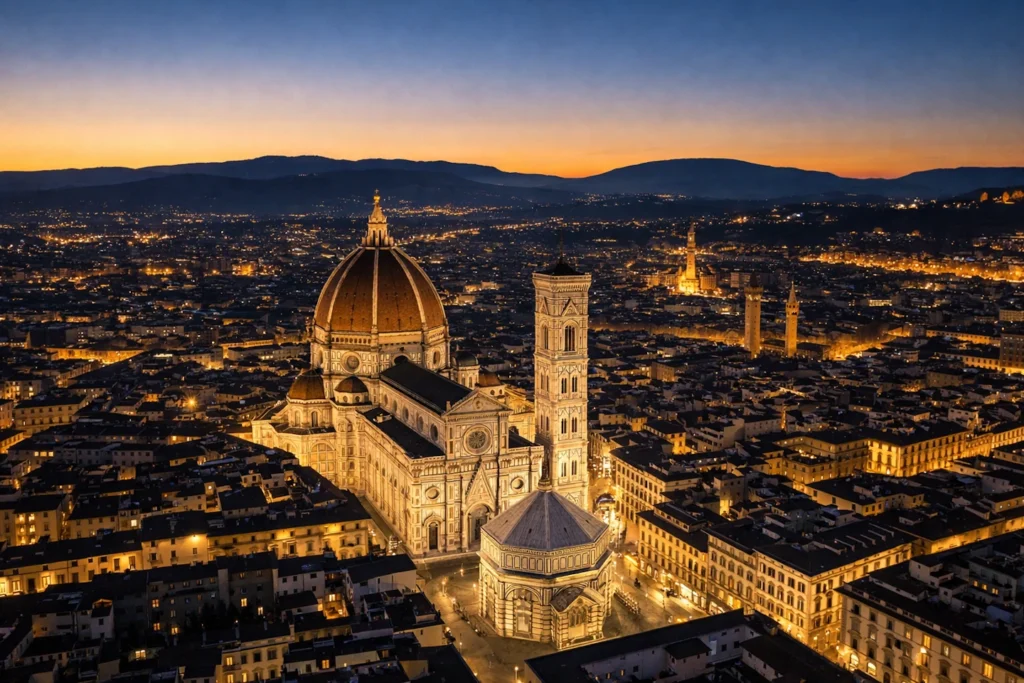
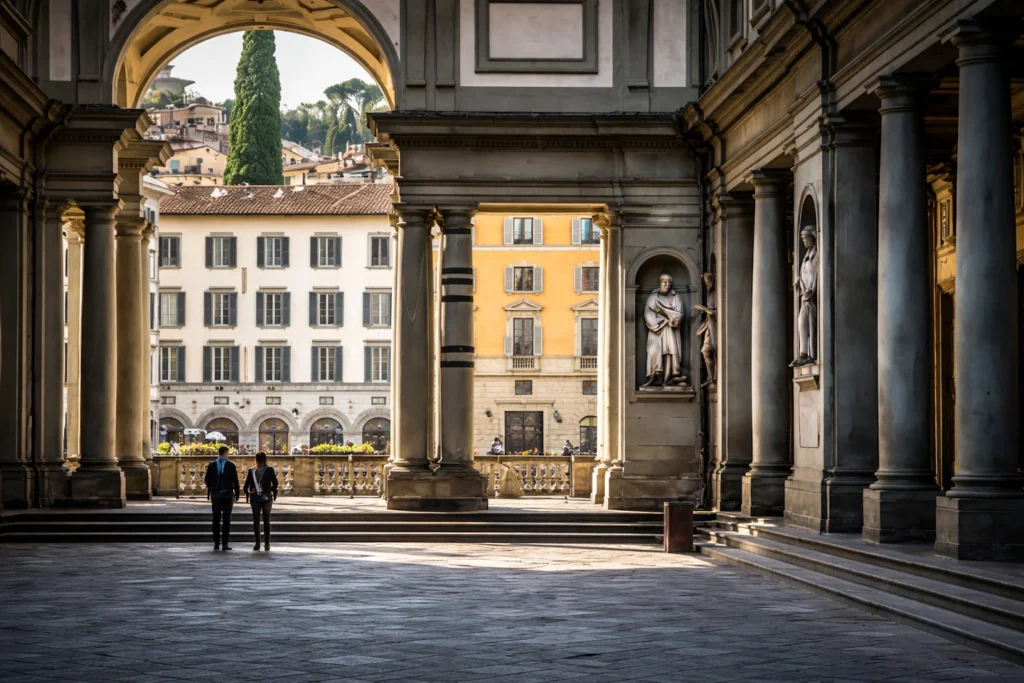
Florence is instantly recognisable for the density of its masterpieces, a city where architecture, painting, sculpture, and civic space feel welded into one continuous experience. Its Historic Centre has been a UNESCO World Heritage Site since 1982, and part of its power lies in how much of the Renaissance remains physically legible at street level, not as a sequence of isolated monuments, but as a coherent urban grammar of stone, proportion, and public life. Florence was shaped by wealth, competition, and patronage, yet what survives is more than splendour: it is a city where art became a civic language, where workshops, guilds, churches, palaces, and museums still speak to each other in a way that makes the visit feel unusually complete.
At a glance
- Drive time from Villa Vianci: 54 min
- Best for: art lovers, first-timers, mixed-age groups
- Time needed: full day
- Booking tip: reserve timed tickets if you want Uffizi / Accademia
- Highlight: Oltrarno at the end of the day
What to see in Florence
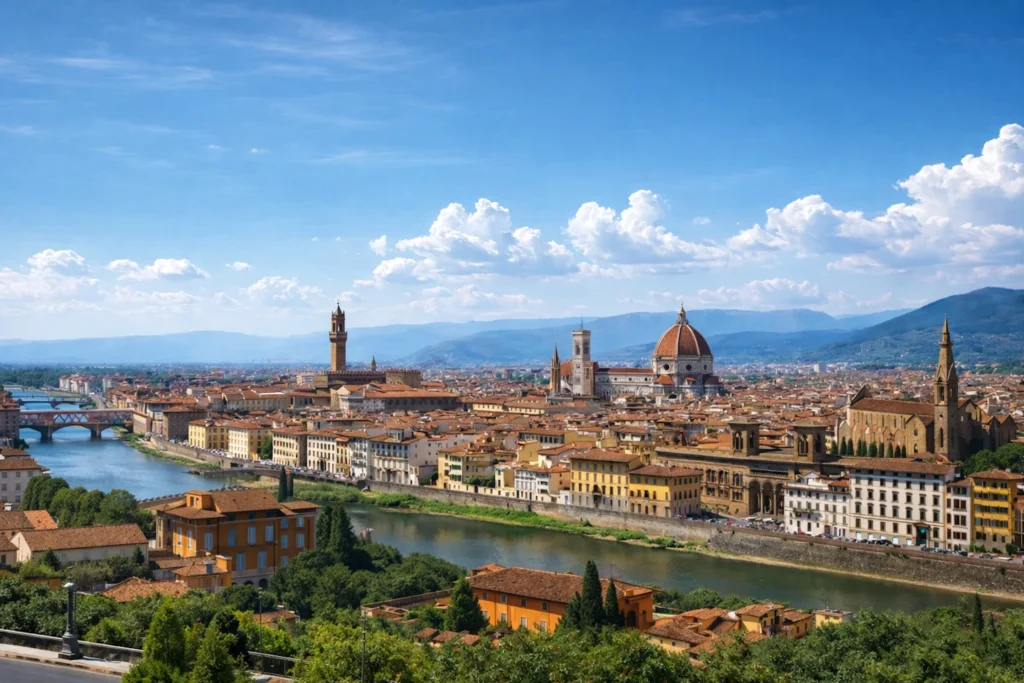
Begin with Florence’s most concentrated statement of ambition, the Duomo complex. The Cathedral of Santa Maria del Fiore is not only a landmark, it is an idea made stone, and the city’s key lesson in scale and engineered beauty. Brunelleschi’s dome is best understood as both architecture and intellect: even before you climb, linger outside to read the surfaces, the rhythm of marble, the precision of the design. Then give real time to the Baptistery and its doors, because Florence’s artistic identity often starts here, narrative carved into bronze, a city telling its stories in public. If you want the Duomo experience to feel complete rather than rushed, add the Museo dell’Opera del Duomo, where originals and context let you understand how sculpture, devotion, and civic pride were meant to work together. The climb to the dome, or Giotto’s bell tower, is not a checklist item, it is the moment Florence becomes readable as an urban system: roofs, corridors of streets, and the Arno cutting the city into two complementary halves.
From sacred Florence, move to civic Florence in the most direct way, Piazza della Signoria. This is where the city’s political theatre becomes visible, an outdoor stage built to make power feel public and concrete. Step into Palazzo Vecchio for the interior counterpart, rooms that still carry the weight of government, ceremony, and calculated display. Nearby, the Uffizi should not be approached as “the museum everyone does”, but as Florence’s visual autobiography, painting as a civic archive. The key is pace: choose a few anchors and allow them to breathe, Botticelli’s mythologies as public imagination, Leonardo’s tension between science and grace, Raphael’s ease, Caravaggio’s force, and the long line of Florentine drawing that makes the Renaissance feel like a method, not a style. If you want one clear way to keep the Uffizi from becoming overwhelming, treat it as a narrative of how Florence learned to see, line, space, anatomy, light, and the dignity of the human figure.
Then step outside and let the city recompose you. Walk down toward the Arno, cross near Ponte Vecchio, and consider this not as a photo stop, but as a hinge between two Florences. On one side, the monumental centre. On the other, the Oltrarno, where the city’s craft identity and slower rhythms still feel present. This is where Santo Spirito matters. The church’s calm, Brunelleschian clarity is the opposite of spectacle, and that is precisely its elegance, proportion as a form of quiet authority. Keep the Oltrarno thread and make room for the Brancacci Chapel in Santa Maria del Carmine. It is one of those visits that recalibrates your whole sense of early Renaissance painting: the figures are not decorative, they are built, weighted, psychologically present, and you can feel a new realism being invented on the wall.
If your aim is explicitly art and culture, give Florence at least one of its “smaller” museums that acts like a key rather than a crowd. The Bargello is perfect for this, because it lets sculpture speak with unusual clarity, form, tension, and the Renaissance love of the body as structure. Pair it with the Accademia if you want the shock of one work done properly: Michelangelo’s David is not only iconic, it is an argument about scale, civic identity, and what human potential was imagined to mean in stone. To balance the canonical Florence with something more humane and socially intelligent, add the Museo degli Innocenti. The building itself carries Brunelleschi’s language of order, but the museum reframes Florence through care, childhood, and institutions, a city not only of power, but of organised responsibility.
Florence also rewards visitors who build one deliberate “church route” that is not redundant with the Duomo. Santa Croce gives you a sense of the city’s civic memory and monumental mourning, while Santa Maria Novella offers a different kind of refinement, disciplined space, art integrated into an elegant urban threshold. If you want a Medici layer that feels more like biography than mythology, consider the Medici Chapels at San Lorenzo, where dynastic power becomes architecture and sculpture, and where Florence’s political story is inseparable from its artistic one.
Because this is a living cultural capital, it is worth reserving one slot for the contemporary programme that keeps Florence from turning into a museum-city. Palazzo Strozzi is often the clearest choice for major exhibitions with serious curatorship, and it gives your trip a present-tense intelligence. In the same spirit, keep an eye on what is happening at the Fortezza da Basso, where large exhibitions, fairs, and cultural events can unexpectedly add something vivid and non-touristic to a Florence stay. The point is simple: Florence is at its best when it is not only remembered, but still producing culture.
To complete the visit with one distinctly Florentine layer, give yourself at least one long, unhurried walk with no “targets”. Move from the centre into quieter streets, notice workshop signs, small courtyards, the way stone changes colour with the light, and let the density work on you. Florence is not a city you “finish”. It is a city you tune into, where beauty feels structural, and where even a short stay can feel like a complete education in form.
Nearby - Fiesole
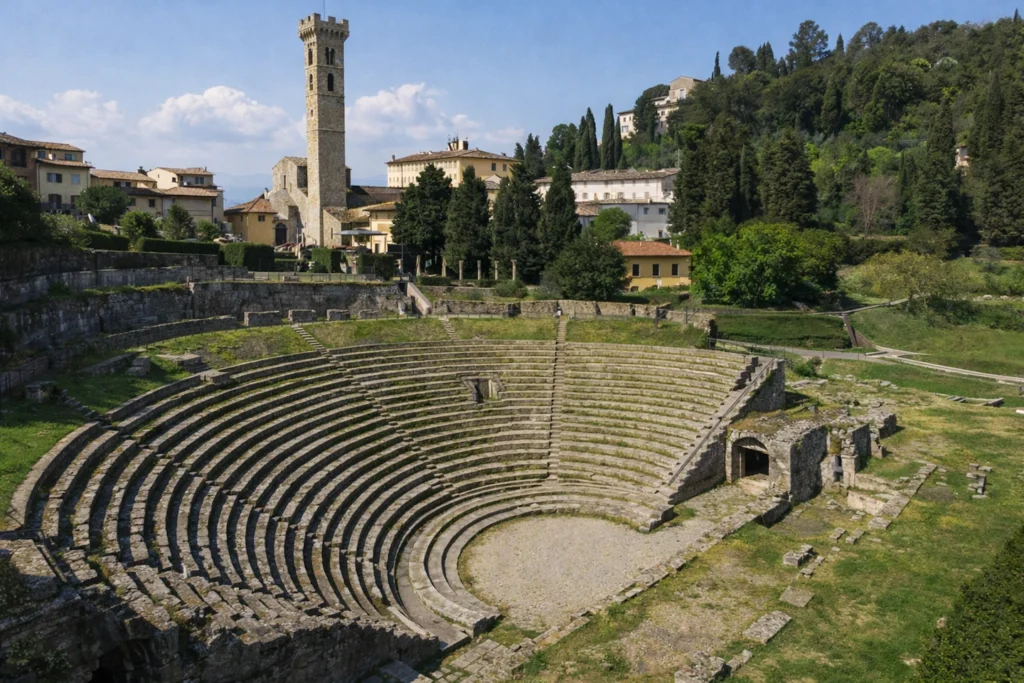
If you want a nearby excursion that stays firmly within art, history, and atmosphere, Fiesole is an exceptional choice, close enough to feel effortless, yet different enough to reset the eye. The Roman Theatre and the archaeological area are the anchor, because they make the classical layer of Tuscany tangible, seating, stage, and the idea of public life carved into a hillside. From there, the town rewards a slower pace, viewpoints that open over Florence, traces of older Etruscan presence, and a compact centre that feels cultured rather than busy. Done well, Fiesole works as the perfect counterpoint to Florence’s intensity: a shorter day, a clearer horizon, and a reminder that this landscape has been shaped by civilisation for a very long time.