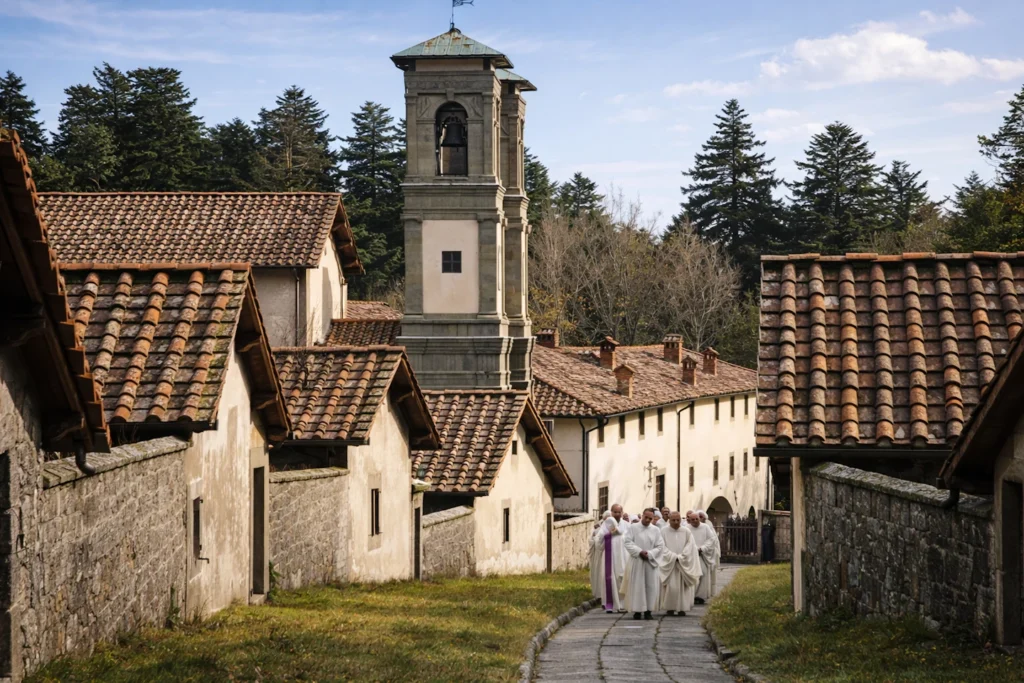
Casentino is a little farther from Villa Vianci than the “easy classics”, but it is worth signalling for guests who want a middle-valley Tuscany: less harsh and abrupt than Garfagnana, less “composed and postcard” than Val d’Orcia. Here the protagonist is the forest. The Casentino sits inside the Parco Nazionale delle Foreste Casentinesi, Monte Falterona e Campigna, a landscape of deep woods, clear air, and spiritual sites that feel naturally woven into nature rather than placed on top of it.
At a glance
- Drive time from Villa Vianci: 131 min
- Best for: hikers and scenery lovers, families with outdoors-focused kids, travellers who want sacred forests and quieter cultural layers
- Time needed: full day
- Booking tip: keep the route flexible, but pre-book any guided or timed visits (especially if you want structured monastery experiences)
- Highlight: the National Park’s forest walks plus the triangle of Camaldoli, La Verna, and carefully chosen “inside-the-place” stops
What to see in Casentino
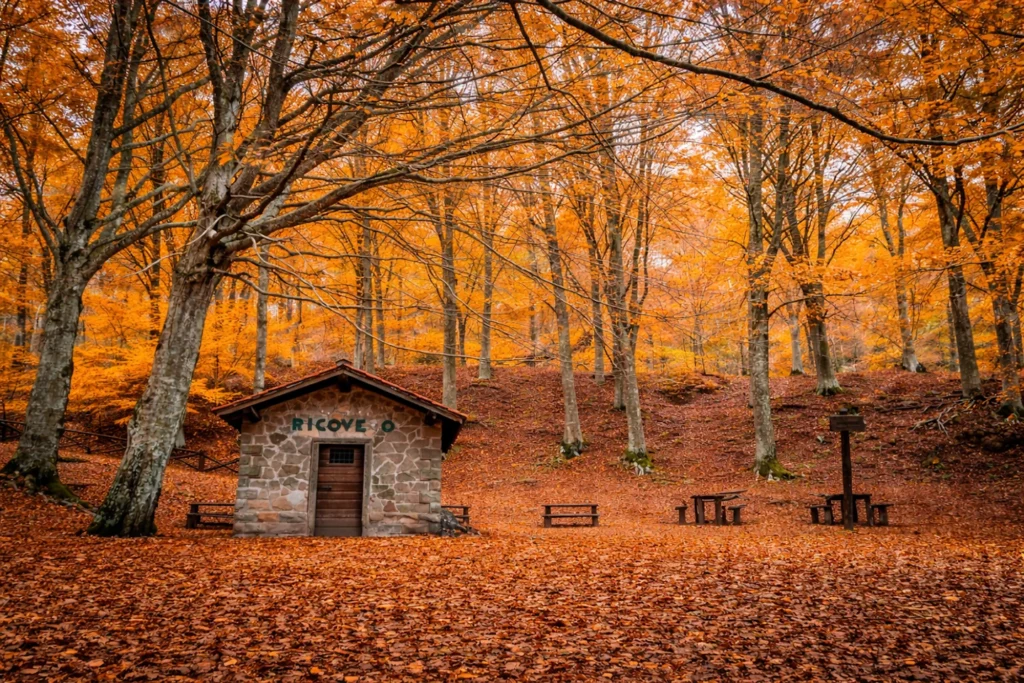
Start with the forest dimension, not with a town. The Park is one of the most immersive wooded landscapes in central Italy, and it rewards a simple approach: choose one walk and actually do it, even if it is only 60 to 90 minutes. One of Casentino’s quiet distinctions is that parts of these woods are internationally recognised for their ecological value. The Park’s “ancient beech forests”, linked to the strictly protected area of Sasso Fratino, are included in UNESCO World Heritage listings for Europe’s primeval beech forests, a reminder that this is not only “pretty scenery”, but a living archive of ecosystems.
Then build your day around Camaldoli, because it is the clearest point where nature and interior life meet. What makes Camaldoli special is its double structure: the Monastery (a cenobitic, community rhythm) and the Sacred Hermitage (an eremitic, more silent rhythm), two ways of living the same tradition in two different architectural languages. Even if you only visit briefly, the setting itself teaches you something: forest, stone, restraint, and a sense of attention that feels contemporary in its calm. If your group appreciates places of culture that are not “for tourists”, note that Camaldoli’s hospitality is explicitly conceived as open and welcoming, and is often described as a space where spiritual life can be approached with seriousness and freedom, including by people who do not identify as believers.
If you want a walk with a clear symbolic “destination”, consider the Monte Falterona side of the Park, where routes connect forest, ridgeline viewpoints, and the area traditionally associated with the source of the Arno. It is a satisfying way to make the day feel narrative: you are not only walking, you are moving toward a geographical origin that has shaped Tuscany’s history and imagination.
Now add the most emotionally powerful stop in the wider Casentino: La Verna. The sanctuary is set in a dramatic forested mountain environment, and even a short visit can feel intense in the best sense: chapels, paths, and viewpoints that make the place feel like an inward walk as much as an outward one. For a very specific, memorable detail, seek out Sasso Spicco, the great rock overhang associated with Saint Francis’s prayer and retreat. It is one of those physical spaces that explains, without rhetoric, why certain landscapes become spiritual magnets.
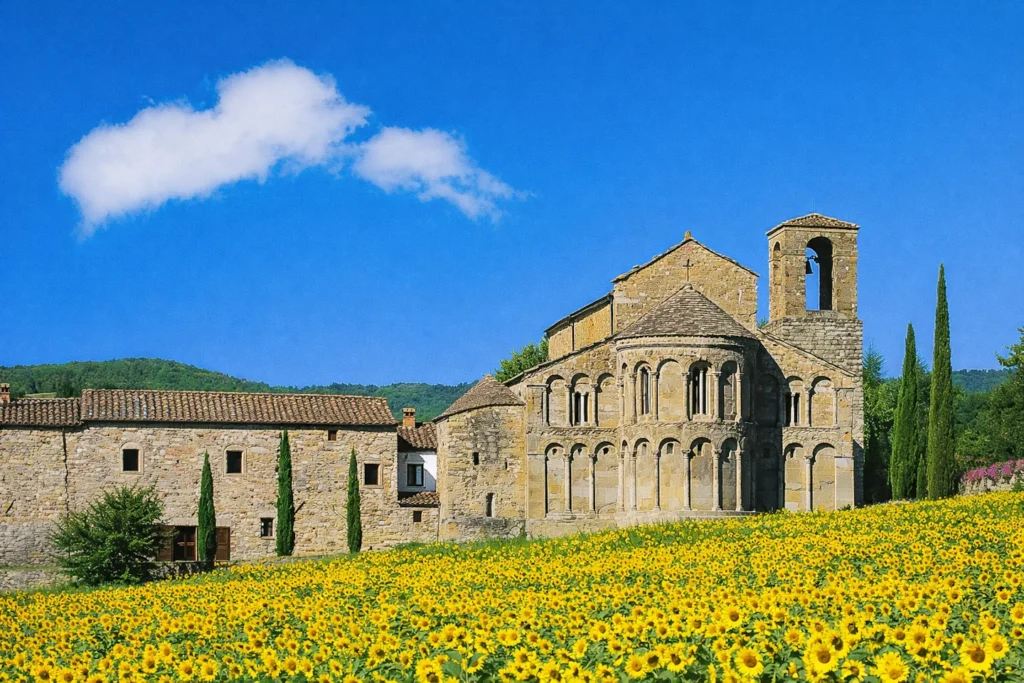
Nearby – Pieve di Romena
If you want one nearby detour that shifts the day from “beautiful forest” to living culture, choose the Pieve di Romena. Beyond its Romanesque simplicity, it is closely associated with the Fraternità di Romena, a community that hosts a very active programme of meetings, reflections, and shared life. What many visitors find distinctive is the tone: a form of Christianity presented in an open, hospitable key, explicitly attentive to dialogue and to people who are searching, including those who do not define themselves as believers. It is a place where the spiritual dimension is lived as fraternity, culture, and welcome, rather than as a closed identity.