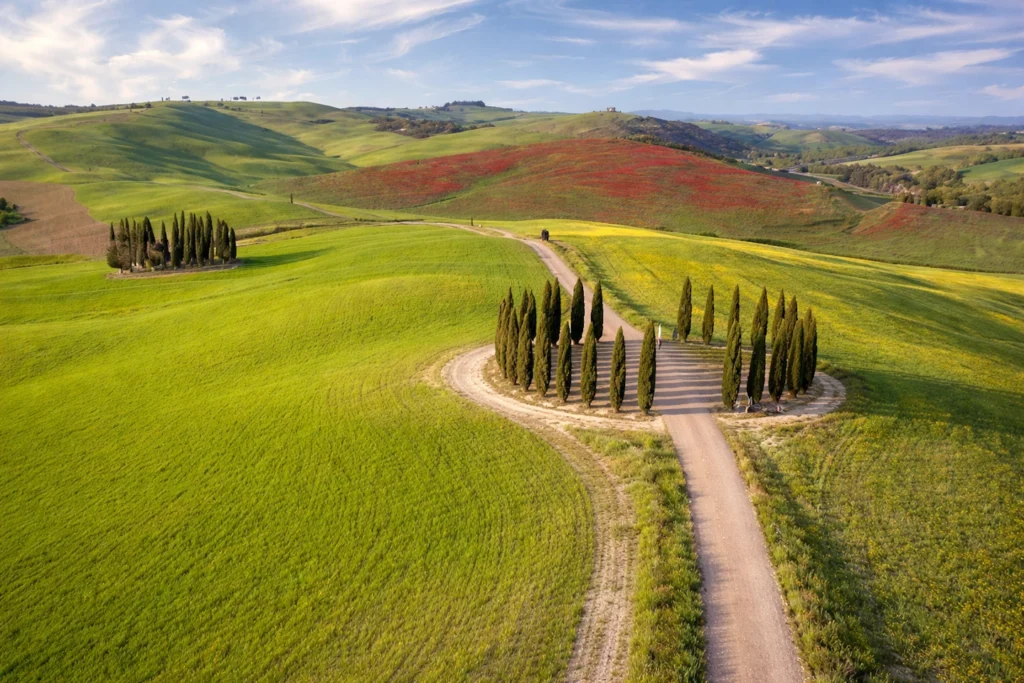
Val d’Orcia is not a “single destination” day. It is a UNESCO cultural landscape where the pleasure comes from moving through space: long sightlines, disciplined geometry, cultivated fields, and those iconic Tuscan rhythms that feel almost composed. UNESCO describes it as a landscape that was reshaped and celebrated as an idealised Renaissance image, influential in painting and in the way “good governance” was visually imagined.
At a glance
- Drive time from Villa Vianci: 64 min
- Best for: scenery lovers, photographers, art and architecture guests, wine lovers, families who enjoy a “moving itinerary”
- Time needed: full day
- Booking tip: book any tastings or guided visits ahead, then keep the rest flexible
- Highlight: a thermal-water places, Romanesque stone, and some of Tuscany’s most recognisable viewpoints
What to see in Val d’Orcia
Start with the landscape itself, not with a town. The iconic feeling of Val d’Orcia is born on the roads and the “in-between” spaces: gentle climbs, open fields, and viewpoints that appear as you turn a bend. A good first rhythm is to park once and walk a little, even if it is only 20 to 40 minutes. The short walk to the Cappella della Madonna di Vitaleta (reached via a white-road path through open countryside) is a classic for a reason: it gives you a clean, cinematic sequence of fields, cypresses, and distant ridgelines, with a clear destination that feels earned rather than staged.
Then make thermal water the centre of the day, because it is one of the valley’s most distinctive “nature-meets-history” signatures. Bagno Vignoni is unique in Tuscany: its main square is dominated by the famous thermal basin (beautiful to see, not for bathing), and just below the village the Parco dei Mulini reveals how water shaped life here. You walk into a small thermal-water world of stone channels, travertine textures, and the remains of ancient mills that used the warm flow. It is a compact visit but surprisingly memorable, because it makes the valley feel physical and specific, not only “pretty”.
If you want a longer walk that still feels coherent and legible, use the valley’s pilgrim geography. The Via Francigena crosses Val d’Orcia and links viewpoints naturally. One rewarding approach is to experience a short portion of the route around San Quirico, Vignoni, and Bagno Vignoni: it is a landscape designed for walking, with changing angles over the valley and a sense of moving “through” history rather than stopping at it. Even if you do not do a full stage, borrowing a segment of the Francigena gives the day a quiet narrative: you are not just looking, you are travelling.
To add a more “wild” register without leaving the Val d’Orcia mood, consider the Riserva Naturale Regionale Ripa d’Orcia. This protected area offers a different texture: deeper folds in the terrain, river views, and the sense of the Orcia as a living line rather than a postcard backdrop. It is ideal if your group wants a real walk rather than only short scenic strolls, and it pairs naturally with the thermal-water stops because both are about the valley’s geology in action.
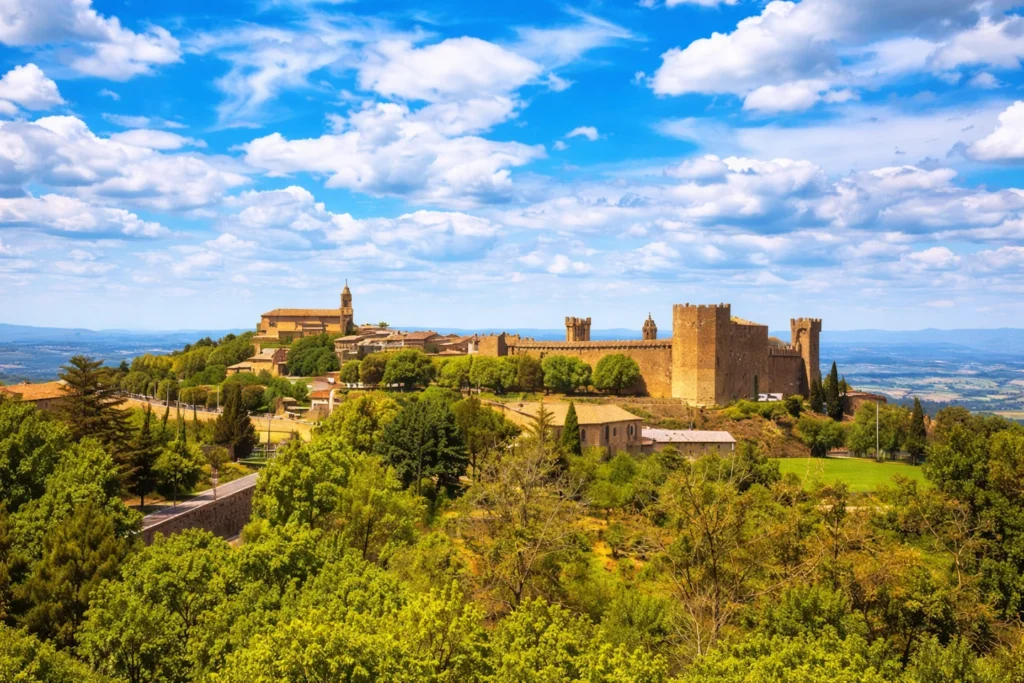
Now bring in the “inside the places” layer, but keep it as targeted attractions rather than a town-by-town checklist. In Montalcino, the simplest and most satisfying nature-facing experience is the Fortezza walk: ramparts, air, and a wide valley outlook that helps you read the geography you have been driving through. In Montepulciano, choose one stop that feels countryside-rooted rather than “street-led”: the Tempio di San Biagio, set just outside the historic centre, is a Renaissance masterpiece placed in open landscape. Even a brief visit works well in a Nature and Walks day because it is about setting as much as architecture, and the approach gives you that pleasant sense of arriving on foot into something calm and proportioned.
Finally, if you want one garden-style pause that feels refined and restful, Horti Leonini in San Quirico is a beautifully structured green interlude: a place to slow the tempo, reset attention, and let the day stay elegant rather than rushed. Many Villa Vianci guests find that this mix is the secret of Val d’Orcia: alternating open landscape with a few concentrated “designed” spaces, so the day remains varied without becoming heavy.
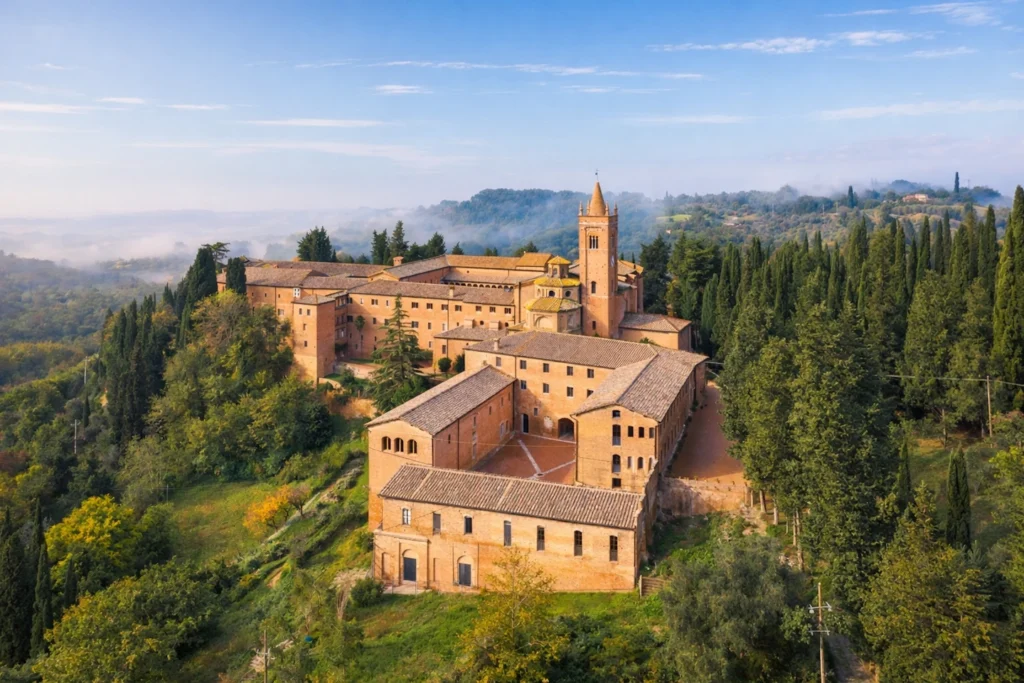
Nearby - Abbey of Monte Oliveto Maggiore
If you want a single nearby detour that feels substantial and different, choose Monte Oliveto Maggiore. Beyond the monastery atmosphere, the key reason to go is the Chiostro Grande fresco cycle on the life of Saint Benedict, with scenes by Luca Signorelli and Il Sodoma. It is one of those places where “day trip” becomes quietly unforgettable, because art, architecture, and setting reinforce each other instead of competing.